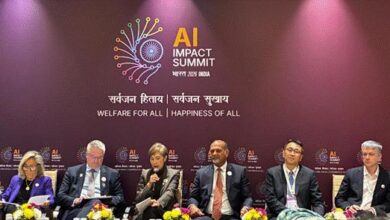
At the India AI Impact Summit 2026, the tone shifted from celebration to construction.
If earlier conversations focused on the brilliance of algorithms and the velocity of innovation, this fresh set of keynote addresses confronted a harder truth: artificial intelligence will only be as strong as the systems that sustain it. Models may dominate headlines, but infrastructure, governance, and global cooperation will determine whether AI becomes a force for shared prosperity – or concentrated power.
The Physical Backbone of Intelligence
Giordano Albertazzi, Chief Executive Officer of Vertiv, delivered a necessary reality check. AI, he argued, is not merely code. It is concrete, copper, cooling systems, and continuous power.
“When we talk about AI, we must also talk about data centers,” he said.
Then came the analogy that framed the session: If AI is the brain, infrastructure is the body. And like any body, it must be fully integrated – engineered as a single, orchestrated system capable of supporting speed, scale, and density.
This is where ambition meets engineering. AI workloads are exploding. Chips are becoming more powerful and energy-hungry. Data centers must now manage unprecedented thermal loads while maintaining uptime and sustainability. The exponential curve of AI innovation demands a proportional evolution in energy systems, grid resilience, and intelligent cooling.
Albertazzi’s message was clear: the AI revolution is not virtual. It is industrial.
Geneva and the Moral Compass of AI
From engineering, the conversation moved to ethics and diplomacy.
Thomas Schneider, Ambassador and Vice-Director at Switzerland’s Federal Office of Communications, announced that Geneva will host the next AI Summit in 2027. But this was not an invitation to spectacle.
“Our motivation is not to stage a show,” he emphasised, “but to make a meaningful contribution.”
His remarks anchored AI within a broader humanitarian framework. AI, he insisted, must raise – not lower – the quality of life for all people. In a world increasingly fractured by geopolitical competition, that statement carries weight.
Geneva has long been synonymous with diplomacy and multilateralism. Hosting the next summit there signals a commitment to pragmatic cooperation rather than regulatory fragmentation. The aim is not to stifle innovation, but to align it with human dignity, peace, and long-term societal benefit.
The subtext was unmistakable: AI governance must be collaborative, not coercive.
The Printing Press Moment
If infrastructure is the body and governance the conscience, access is the soul of technological transformation.
Matthew Prince, CEO of Cloudflare, invoked history to make his case. Like the printing press – which began in Germany but spread rapidly across Europe – AI must not be confined to a handful of corporations or countries.
The printing press democratised knowledge. AI, he argued, should democratise capability.
“AI shouldn’t remove our humanity; it should accelerate and enhance it.”
Prince warned against a future where AI tools are accessible only to the wealthy or technologically dominant nations. Innovation thrives when distributed. Culture flourishes when diverse voices have tools to create, build, and scale.
The real danger is not AI becoming powerful. It is AI becoming exclusive.
India’s Strategic Moment
Closing the session, Marcus Wallenberg, Chairman of SEB and Saab, underscored India’s defining opportunity.
By convening leaders across sectors and geographies, India demonstrated national resolve and industry alignment – a formula that has powered its digital transformation over the past decade. As AI diffuses across industries, Wallenberg noted, it will unlock not only competitiveness but entirely new business models and societal outcomes.
India’s advantage lies in scale – its vast talent pool, strong IT ecosystem, and experience in building digital public infrastructure. If aligned with resilient infrastructure and inclusive governance, that scale can translate into global leadership.
Beyond Models
What emerged from this segment of the Summit was not technological hype, but structural clarity.
AI’s next chapter will not be defined solely by breakthroughs in model architecture. It will be shaped by resilient data centers, sustainable energy systems, multilateral cooperation, and open access frameworks that ensure benefits are widely shared.
In other words, intelligence must be built on integrity.
The India AI Impact Summit 2026 made one thing evident: the future of AI will not belong to the fastest innovator alone. It will belong to those who understand that brains need bodies, power needs principles, and innovation needs inclusion.
Only then can artificial intelligence truly elevate humanity – rather than merely impress it.