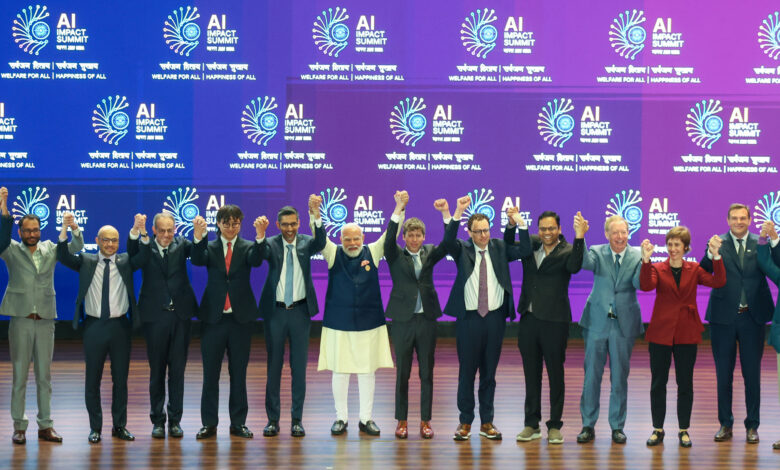
At a time when the world is oscillating between awe and anxiety over Artificial Intelligence, Prime Minister Narendra Modi stood before global leaders at the India AI Impact Summit 2026 in New Delhi and attempted something rare in technology discourse – he injected morality into the machine.
Speaking at the Leaders’ Plenary Session at Bharat Mandapam, Prime Minister Modi did not present AI as a geopolitical weapon, nor as a corporate gold rush. Instead, he framed it as a civilisational responsibility.
And that distinction matters.
History, he reminded the world, has shown that humanity has always converted disruption into opportunity. The Industrial Revolution, the Digital Revolution, and now the Intelligence Revolution. Each phase arrived with chaos, uncertainty and fear. Yet each time, mankind rose – not because technology was perfect, but because human intent corrected its direction.
Modi’s message was clear: AI must not become a tool of domination. It must remain an instrument of service.
He invoked Lord Buddha’s timeless teaching – ‘Right Action comes from Right Understanding’. It was not a spiritual detour; it was a strategic warning. Artificial Intelligence without ethical intelligence is merely amplified power. And amplified power without wisdom becomes amplified harm.
The Prime Minister’s argument drew strength from recent memory. During the COVID-19 pandemic, when borders closed and fear spread faster than the virus itself, global cooperation became the only vaccine against collapse. Nations collaborated on vaccine development. Supply chains were stabilised. Data was shared. Lives were saved.
India, he pointed out, witnessed firsthand how technology can serve humanity. The CoWIN digital platform ensured millions were vaccinated in an orderly, transparent manner. The Unified Payments Interface (UPI) kept financial transactions flowing when physical interaction was restricted. In moments of crisis, digital public infrastructure became not just a convenience but a lifeline.
And here lies the philosophical pivot of Modi’s address: For India, technology is not a medium of power – it is a medium of service. Not to dominate, but to empower.
This worldview sharply contrasts with the prevailing global narrative where AI supremacy is increasingly viewed through the prism of military advantage, economic monopoly, and technological control. Modi subtly repositioned India not as a competitor in the AI arms race, but as a moral voice advocating for inclusive intelligence.
He acknowledged a truth many hesitate to admit: previous technological revolutions created divisions. Access was uneven. Wealth concentrated. Inequality widened. If AI follows the same path, it could deepen global fractures.
That is why he insisted the aspirations of the Global South must be placed at the center of AI governance.
In a world where data is the new oil, nations of the Global South risk becoming mere data mines for technology giants headquartered elsewhere. Modi’s emphasis on inclusion was not rhetorical – it was geopolitical. AI governance cannot be written in boardrooms of a few wealthy nations while billions remain passive consumers.
Ethics, he stressed, have always accompanied human progress. But AI presents a unique challenge – the scale of unethical behaviour it can enable is potentially unlimited. From misinformation to autonomous weapons, from algorithmic bias to emotional manipulation, AI can magnify human flaws at machine speed.
Therefore, ethical norms must also be unlimited.
In a direct message to AI companies, Modi stated that profit cannot be the sole compass. Purpose must guide innovation. The private sector’s responsibility extends beyond shareholder returns; it includes societal trust.
This is where his address turned practical.
He offered three foundational suggestions for ethical AI.
First, data sovereignty and trust. AI training must respect national data rights and operate within a trusted global framework. “Garbage in, garbage out,” he reminded the audience. If data is insecure, biased, or manipulated, the output will be flawed. An algorithm is only as ethical as the data it consumes.
Second, transparency. Modi called for replacing “black box” AI systems with a “glass box” approach. Safety rules must be visible, verifiable, and accountable. Algorithms that cannot be questioned should not be blindly trusted. In an era where AI decisions may affect healthcare, finance, justice, and governance, opacity is unacceptable.
Third, human values must guide machine goals. He referenced the famous “paper clip problem” – a theoretical scenario where a machine tasked with maximising paper clip production consumes all global resources to fulfill its objective. The analogy was simple but profound. Machines pursue goals relentlessly. Humans must define those goals wisely.
Technology is powerful. Direction must remain human.
Yet, this was not merely a philosophical sermon. Modi positioned India as an active participant in shaping the AI future.
Under India’s AI Mission, 38,000 GPUs are already operational, with 24,000 more to be added in the next six months. This is not incremental ambition – it is infrastructure-scale preparation. By providing startups with world-class computing power at affordable rates, India is democratising AI development rather than centralising it.
Equally significant is AIKosh – the National Dataset Platform – through which over 7,500 datasets and 270 AI models have been shared as national resources. This signals an ecosystem approach: open data, accessible models, collaborative innovation.
In essence, India is building not just AI capacity, but AI commons.
Modi’s concluding thought carried the weight of civilisational confidence. India’s direction is clear: AI is a shared resource for the welfare of humanity. Innovation must advance inclusion. Progress must integrate human values. And global trust must accompany technological acceleration.
In an age where algorithms shape perception, influence elections, recommend news, predict behaviour, and even compose thoughts, the greatest risk is not machine intelligence surpassing human intelligence. The greatest risk is human morality lagging behind machine capability.
The Prime Minister’s address did not pretend that regulation alone can solve the AI dilemma. Nor did it demonise technological progress. Instead, it called for a balance – innovation with inclusion, scale with sensitivity, ambition with accountability.
When technology and human trust move together, he said, the true impact of AI will be visible.
That may well be the defining test of this century.
The India AI Impact Summit 2026 was not merely about computing power, datasets, or machine learning models. It was about a moral proposition: Can humanity build intelligence without losing wisdom?
If India’s approach prevails – service over supremacy, inclusion over insulation, ethics over excess – then AI could indeed become humanity’s greatest opportunity.
But if the world chooses power over purpose, we may build machines that are intelligent, yet indifferent.
The machine age has begun. The moral age must begin with it.
And in New Delhi, at Bharat Mandapam, a clear message was sent: The future of AI will not just be coded – it will be chosen.