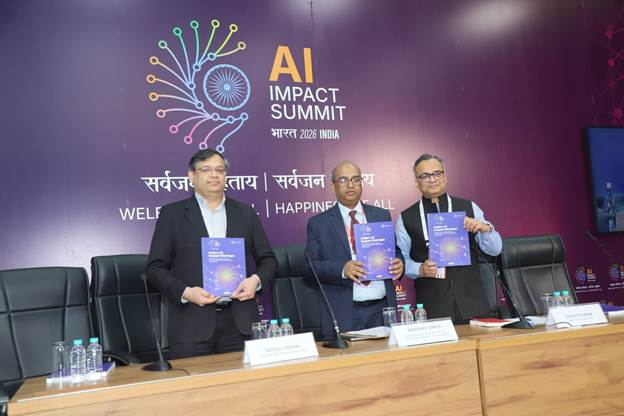
At the India AI Impact Summit 2026, something far more consequential than glossy presentations and exhibition showcases quietly took centre stage. Titled “India’s AI Impact Startups”, a first-of-its-kind repository profiling over 110 startups and non-profits, the publication signals a defining shift in India’s artificial intelligence journey. This is not about hype cycles. This is about national capability. And it is about India solving India’s problems with Indian intelligence.
Released by IndiaAI and Kalpa Impact, the repository offers the first structured mapping of India’s AI-for-impact ecosystem. It spans healthcare, agriculture, education, climate action, financial inclusion, urban mobility and public service delivery. In a nation of 1.4 billion people, scale is not optional – it is existential. And what this repository reveals is that Indian founders are no longer experimenting at the margins; they are building solutions designed to operate at population scale.
For policymakers, investors and global development institutions, this publication serves as a blueprint of readiness. It documents how Indian startups are designing AI solutions rooted in local realities yet globally relevant. This is not abstract artificial intelligence trained on distant datasets. This is AI that understands dialects, works in low-connectivity environments and addresses everyday governance bottlenecks. It is as comfortable advising a smallholder farmer as it is assisting a district hospital.
One of the most striking insights is the dominance of voice AI and vernacular interfaces. In a country where English is not the primary language for the majority, voice becomes the bridge between technology and citizen. AI that speaks Marathi, Tamil, Assamese or Hindi is not merely innovative – it is transformative. Inclusion, in India, is infrastructure. And voice is emerging as its most powerful conduit.
Abhishek Singh, Additional Secretary at the Ministry of Electronics and Information Technology and CEO of the IndiaAI Mission, rightly described the repository as a practical resource aligned with public objectives. Policymakers today are not searching for speculative prototypes; they require integration-ready solutions that can plug into India’s digital public infrastructure. AI that enhances telemedicine, strengthens service delivery and optimises welfare schemes is no longer aspirational – it is operational.
Mohammed Y. Safirulla K of the IndiaAI Mission observed that Indian startups are transitioning from promising pilots to deployed, scaled systems serving millions. That transition marks maturity. India’s AI ecosystem is consolidating, not just experimenting. It is building staying power.
Anshul Singhal of MeitY pointed to the diversity of challenges being addressed – from courtroom transcription and rural health screening to smallholder farm advisory systems. These are not vanity projects designed for applause at tech conferences. They are governance multipliers. When AI reduces case pendency or enables early disease detection in remote districts, it strengthens the republic.
Kalpa Impact founder Sushant Kumar’s description of Indian AI as “super-utility” captures the ethos perfectly. Indian startups are not chasing novelty; they are delivering necessity. A growing number of growth-stage companies have already expanded internationally, positioning India as an AI export hub for emerging economies. From edge AI solutions that function offline to voice bots fluent in local dialects, Indian founders are building full-stack solutions uniquely suited to the subcontinent – and increasingly relevant to the world.
For decades, India was labelled the back office of the global technology revolution. Today, it is scripting its own narrative. The release of this repository is more than documentation; it is a declaration of intent. India’s AI story is not about imitation. It is about innovation with inclusion at its core – scalable, sovereign and shaped for Bharat.
That is not just progress. That is purpose.