Youth Rising, India Leading: How the India AI Impact Summit 2026 is Shaping a Sovereign, Inclusive AI Future

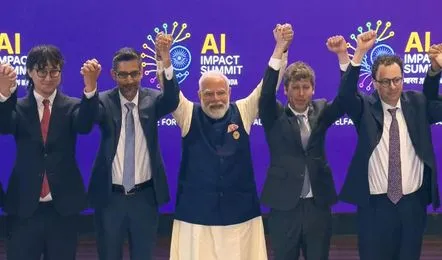
At a time when the world debates whether Artificial Intelligence will replace jobs, redefine economies, or reshape geopolitics, India has chosen a different narrative. At the India AI Impact Summit 2026, the message was clear: India’s AI story will not be written in isolation by machines – it will be powered by its youth.
The Summit did not treat young innovators as future participants. It positioned them as present architects of India’s sovereign AI vision.
Youth at the Core of India’s Sovereign AI Vision
In the session on “Scaling Impact from India’s Sovereign AI and Data,” the emphasis was unmistakable – India’s AI destiny must be indigenous, accountable, and development-driven. Sovereign AI is not about technological isolation; it is about technological self-confidence.
For India to build foundational models rooted in its linguistic diversity, cultural contexts, and grassroots realities, it requires deep research talent. It requires engineers who understand Bharat beyond Bengaluru, coders who appreciate agriculture as much as algorithms, and innovators who build for inclusion rather than valuation.
The Summit underscored that young innovators must be trained not just to write code but to build transparent, explainable, and nationally aligned AI systems. AI that speaks India’s languages. AI that understands Indian farmers. AI that supports Indian teachers. AI that strengthens financial inclusion.
By connecting advanced research with sectors such as healthcare, agriculture, education, and financial inclusion, the Summit has effectively turned youth into the driving force of globally competitive, socially impactful AI solutions.
India is not outsourcing its AI ambition. It is incubating it in its classrooms.
From Algorithms to Outcomes
One of the most powerful conversations at the Summit unfolded during the session “From Algorithms to Outcomes.” It addressed a truth often ignored in technology circles: algorithms are meaningless unless they deliver measurable outcomes.
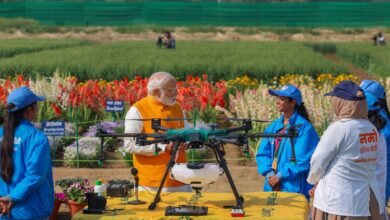
The India AI Mission is structured to convert compute power, data infrastructure, and model-building into deployable, citizen-centric applications. The presence of over 600 startups and companies showcasing solutions across healthcare, agriculture, education, and manufacturing created a living laboratory for young innovators.
For youth attending the Summit, this was not theory. It was exposure to scale.
Global experts highlighted the importance of responsible scaling, rigorous evaluation frameworks, and evidence-based implementation. AI is not innovation theatre. It must solve problems.
This approach reframes youth not merely as technologists, but as outcome-driven problem solvers – individuals who understand that public good is the ultimate benchmark.
YUVAi Global Youth Challenge: From Prototype to Public Good
If there was one initiative that symbolised India’s faith in its young minds, it was the YUVAi Global Youth Challenge.
Targeting innovators aged 13 to 21, YUVAi received over 2,500 applications from 38 countries. Seventy high-potential teams emerged, addressing healthcare gaps, climate resilience, agricultural productivity, accessibility solutions, digital trust frameworks, and smart mobility innovations.
What distinguishes YUVAi is its structured evaluation model. Technical robustness, deployment readiness, and measurable social impact were key criteria. Winning teams did not just receive trophies – they received mentorship, incubation pathways, industry linkages, and ecosystem integration.
India is not celebrating ideas in isolation. It is building bridges from prototype to population-scale deployment.
In doing so, the Summit has reinforced India’s global leadership in responsible and inclusive AI innovation.
AI by HER: Women Leading the Responsible AI Movement
True transformation cannot be achieved without gender inclusion. The AI by HER Global Impact Challenge ensured that women innovators were not participants at the margins, but leaders at the forefront.
Through panel discussions, rapid spotlight pitches, and startup showcases, AI by HER demonstrated that empathy-driven innovation often leads to scalable impact. From fintech and healthcare to climate resilience and digital public infrastructure, women-led AI ventures are solving problems with trust-centric design.
Perhaps the most significant announcement was the launch of a dedicated capacity-building programme for 150 women-led AI startups. This signals a shift from access to acceleration. It ensures that women innovators are supported from ideation to scale.
Inclusive AI is not a slogan. It is an operational framework.
Global Dialogue: AI and the Future of Work
While celebrating innovation, the Summit did not shy away from difficult questions. The session on “Global Dialogue on AI Usage – Data for Labour Market Resilience” examined the changing nature of work in the age of AI.
Emerging global evidence suggests differentiated impacts across age groups, sectors, and geographies. Younger workers, especially in roles with high AI exposure, may face employment pressures.
This is precisely why skilling, reskilling, and adaptive policy frameworks are central to India’s AI roadmap.
India’s demographic advantage is powerful – but only if it is future-ready.
AI Impact Startup Book: Documenting the Use-Case Capital
The launch of the AI Impact Startup Book marked a strategic milestone. Featuring over 100 AI solutions developed across India, the compendium spans healthcare, agriculture, education, foundational models, and edge AI.
More than a publication, it is a blueprint for scale.
By creating a structured mechanism to evaluate and integrate use cases across ministries and state governments, the initiative accelerates the transition from pilot projects to population-scale impact.
India has declared its ambition to become the “use-case capital” within the next 12-18 months. That ambition rests squarely on the shoulders of young entrepreneurs who are building real-world solutions – not vanity metrics.
Global Indicators: India’s Youth-Led AI Leadership
The data reinforces the narrative.
According to the Stanford Global AI Index Report 2025, India’s relative penetration of AI skills is 2.5 times higher than the global average across comparable occupations. This reflects the impact of early and broad-based skilling initiatives.
The NASSCOM AI Adoption Index reveals that 87% of enterprises in India are actively deploying AI solutions. This creates sustained demand for AI-ready youth and strengthens school-to-work pipelines.
Perhaps most encouragingly, over 50% of India’s startups are now emerging from beyond metropolitan cities. Innovation is no longer confined to Bengaluru, Mumbai, or Delhi. Bharat is coding its own destiny.
India’s demographic dividend is not merely numerical – it is digitally adaptable.
Beyond the Summit: A Generational Mandate
The India AI Impact Summit 2026 was not just an event. It was a declaration of intent.
It affirmed that India’s AI future will be sovereign yet collaborative, innovative yet responsible, ambitious yet inclusive. It placed youth leadership and gender diversity at the centre of policy, ecosystem design, and innovation architecture.
Most importantly, it rejected the passive narrative that young people are at risk in the AI revolution. Instead, it presented them as its architects.
If India succeeds in aligning talent, infrastructure, policy, and purpose, it will not merely participate in the global AI race – it will redefine it.
The youth of India are not waiting for the future. They are building it.