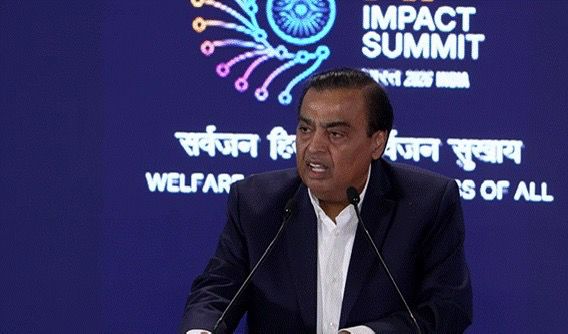
At the India AI Impact Summit 2026, four of the world’s most influential technology leaders took the stage – and in doing so, framed a defining question for our times: Will Artificial Intelligence become the privilege of a few, or the power of many?
The keynote sessions by Mukesh Dhirubhai Ambani, Demis Hassabis, Vishal Sikka, and Rishad Premji were not mere corporate speeches. They were philosophical markers in India’s civilisational journey toward 2047 – the centenary of our Independence and the vision of Viksit Bharat.
Ambani’s Democratised AI Dream
Mukesh Ambani called the Summit a “defining moment in India’s tech history.” In his words, India has chosen a path where AI is “available, affordable, and beneficial to all.” That single sentence captures the ideological divergence in the global AI race.
The world today is witnessing the concentration of compute power, data dominance, and algorithmic control in a handful of corporations and nations. Ambani offered a counter-narrative – one rooted in democratisation over concentration.
His announcement of large-scale investments in sovereign compute infrastructure, green-powered data centres, and edge intelligence signals that India does not intend to be a passive consumer of AI built elsewhere. It intends to build, own, and power it sustainably.
In many ways, this echoes India’s telecom revolution. What mobile telephony did for communication access, AI could do for cognitive access. But the foundation must be sovereign, secure, and scalable.
Hassabis and the AGI Horizon
If Ambani spoke of infrastructure, Demis Hassabis spoke of destiny.
The CEO of DeepMind described 2026 as a “threshold moment,” suggesting that Artificial General Intelligence could be on the horizon within five years. He compared its potential impact to being “10 times the Industrial Revolution, but happening at 10 times the speed.”
Pause and reflect on that scale.
The Industrial Revolution reshaped economies, social structures, and geopolitics over decades. AI could do so in years. The implications for labour, governance, ethics, and even human identity are profound.
Hassabis emphasised scientific rigour and international cooperation – a crucial reminder that AI cannot be governed by nationalism alone. Yet, cooperation must coexist with sovereignty. India must engage globally without surrendering strategic autonomy.
The message was clear: The race to AGI is not just technological; it is moral and civilisational.
Vishal Sikka’s Leapfrog Warning
Vishal Sikka injected urgency into the conversation. His assertion that “people who understand how to use AI are astonishingly effective with it” should serve as a wake-up call to our education systems and corporate leadership.
AI literacy will determine productivity gaps more sharply than English fluency or digital literacy ever did.
But Sikka went further. He warned against complacency. Mastering today’s AI is not enough. “We not only have to master today’s AI, but we have to leapfrog it.”
That is the difference between adoption and innovation.
India has often excelled at adapting global technologies – from software services to fintech. The AI era demands something bolder: foundational research, original models, energy-efficient architectures, and safety-first design.
Sikka also flagged reliability and energy consumption – issues often ignored in celebratory AI narratives. Intelligence without safety is risk. Scale without sustainability is irresponsibility.
Rishad Premji’s Real-World Imperative
If Hassabis spoke of the future and Sikka of capability, Rishad Premji grounded the conversation in execution.
“Technology creates value only when it is applied to solve real world problems responsibly and at scale,” he said. That single line may well define India’s AI philosophy.
From healthcare diagnostics in rural India to agricultural advisories for small farmers, from predictive governance tools to public service delivery optimisation – India is not merely a testbed; it is a consequential environment.
The Indian scale is unmatched. What works here can work anywhere.
Premji’s emphasis on enterprise transformation also signals a shift. AI is not an innovation lab experiment. It is a boardroom mandate. It changes not just what companies can do – but what they must do.
The Indian Equation: Ambition + Responsibility
Taken together, the four sessions reinforced a powerful thesis: India’s AI journey must balance ambition with responsibility, scale with inclusion, and leadership with cooperation.
India’s demographic dividend, its digital public infrastructure, and its entrepreneurial ecosystem provide a unique launchpad. But leadership in AI will not be earned through slogans. It will be built through compute, code, capital, and conscience.
The Summit underscored one central truth: Intelligence must not be concentrated. It must be diffused.
If India succeeds in making AI accessible to its youth, affordable for its enterprises, sustainable for its environment, and responsible in its deployment, then 2047 will not merely mark 100 years of freedom.
It will mark 100 years of evolution – from political independence to technological self-determination.
And at the heart of that journey lies a simple but powerful conviction: The future of AI should not belong to the few who control it, but to the billions who can benefit from it.