At the India AI Impact Summit 2026, there was no mistaking the moment. Artificial Intelligence is no longer a laboratory experiment, nor a Silicon Valley buzzword. It is the new grammar of power – economic, strategic and civilisational. And in a high-level panel that brought together voices from Washington, Abu Dhabi, San José and New Delhi, the world quietly began sketching the blueprint of tomorrow.
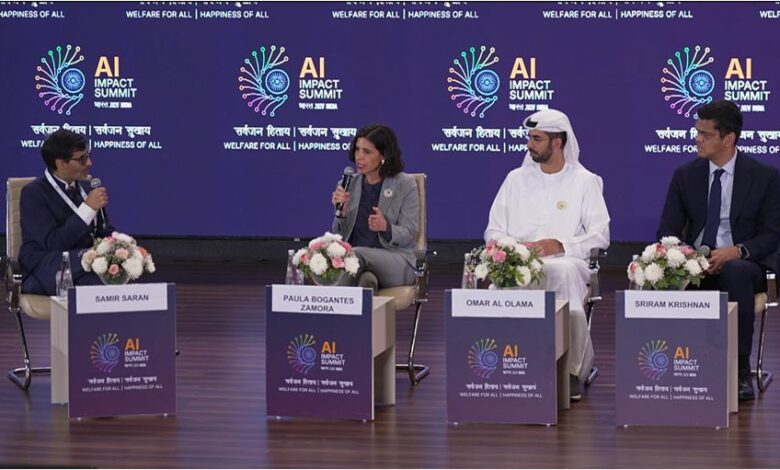
Moderated by Samir Saran, President of the Observer Research Foundation, the discussion framed three urgent themes: impact, diffusion and multilateralism. The questions were not abstract. Who builds AI? Who governs it? And who benefits from it?
The American Pillars: Infrastructure, Innovation, Alliances
Representing the United States, Sriram Krishnan, Senior Policy Advisor for AI at the White House, outlined a crisp, three-pillar strategy – infrastructure, innovation and partnerships.
The first pillar was unapologetically about power – computing power. Expanding data centres. Scaling advanced chips. Ensuring energy sustainability while making compute affordable. In today’s world, the nations that control compute control capability. Krishnan made it clear: AI infrastructure is not a luxury; it is national backbone.
The second pillar was innovation. Entrepreneurs, coders, start-ups – these are not peripheral actors. They are the beating heart of AI leadership. But innovation, he cautioned, must not suffocate under bureaucratic overreach. Regulatory clarity and predictability are essential. Safeguards for child protection, intellectual property and national security must exist – but they must be smart, not strangling.
The third pillar was alliances. Secure supply chains. Technology collaboration. Trusted partnerships. AI is too complex and too consequential to be built in isolation. Shared capabilities demand shared trust.
The UAE’s Human-Centric Diffusion
If America’s language was strategic, the United Arab Emirates spoke of societal transformation. Omar Al Olama, Minister of State for Artificial Intelligence, Digital Economy and Remote Work Applications, brought the perspective of a nation that appointed the world’s first AI minister years before most countries even had an AI roadmap.
For the UAE, AI diffusion is not about elite labs – it is about everyday life. Infrastructure readiness. AI literacy. Responsible deployment. Technology must elevate quality of life, not widen divides.
Al Olama warned against regulatory extremism. Innovation without guardrails is reckless. Regulation without flexibility is regressive. The answer lies in adaptive governance – frameworks that evolve with technology, consult stakeholders continuously, and avoid knee-jerk reactions.
Drawing parallels with earlier technological revolutions, he emphasised dialogue – sustained, inclusive, global dialogue. No nation should be left outside the AI conversation. If AI is the defining technology of this century, then governance must be inclusive by design.
The Voice of Smaller Economies
From Costa Rica came a grounded reminder: AI readiness begins with honest introspection. Paula Bogantes Zamora, Minister of Science, Innovation, Technology and Telecommunications, spoke for smaller and developing economies navigating the AI wave.
Connectivity. 5G deployment. National AI strategies. Data governance frameworks. Research investment. These are not optional checklists; they are foundational enablers.
Bogantes Zamora pointed to stark disparities in digital infrastructure and innovation spending across regions. A one-size-fits-all regulatory model will not work. Each country’s framework must reflect its stage of development.
She stressed regional cooperation – like-minded groupings amplifying collective voices. For smaller nations, collaboration is leverage. Data, she argued, is the new strategic asset. Global conversations must address not just data protection, but data value and equitable access to AI tools.
Before scaling advanced AI systems, countries must build foundational capabilities. Inclusion is not rhetoric; it is infrastructure.
India’s Moment
As the world’s largest democracy and fastest-growing major digital economy, India finds itself at a historic junction. The India AI Impact Summit 2026 has become more than an event – it is a statement. India is not merely participating in AI governance; it is convening it.
Dr. Samir Saran’s framing was deliberate. Impact without diffusion creates inequality. Diffusion without guardrails creates risk. Multilateralism without trust creates paralysis.
The panelists converged on a shared recognition: AI is a transformative opportunity. Economic growth. Societal progress. Improved quality of life. But these outcomes are not automatic. They require deliberate investment in infrastructure, enablement of innovation, responsible regulation and expanded global cooperation.
In many ways, the session reflected a broader truth. AI governance will not be shaped by a single superpower, nor dictated by a single ideology. It will be negotiated – across continents, capacities and cultures.
The architecture of global cooperation is still under construction. But what was clear in that room is this: nations understand the stakes.
The future will belong to those who build compute, cultivate talent, craft intelligent regulation and forge trusted partnerships.
And as India hosts these conversations, it signals something profound – that the age of AI will not be written by one capital alone. It will be co-authored.
If 2026 is remembered for anything, it may well be the year the world stopped debating whether AI would reshape humanity – and began deciding how.