When Prime Minister Narendra Modi inaugurated the India AI Impact Summit 2026, he did not speak of Artificial Intelligence as a luxury of the developed world. He framed it as a moral imperative. AI, he said, must become a tool for inclusion and empowerment – particularly for the Global South. In that single line, he set the tone for a summit that was less about algorithms and more about humanity.
At a time when the world is oscillating between excitement and anxiety over AI, India chose to convene the builders, the regulators, the philanthropists and the corporate architects of the digital future. And what emerged from the keynote addresses of global leaders was not techno-utopian fantasy – but a sober call for responsibility.
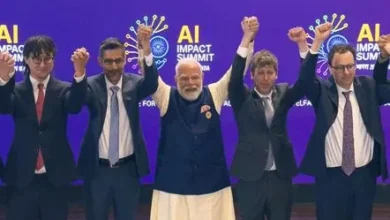
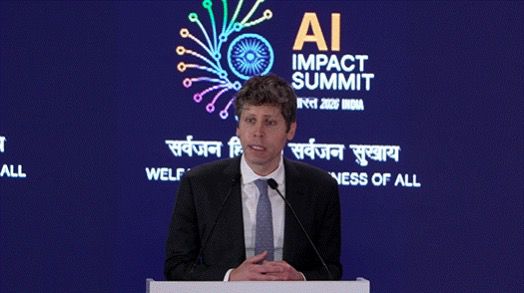
Sam Altman, CEO of OpenAI, delivered what can only be described as a generational warning wrapped in optimism. He spoke of the breathtaking pace of technological progress and placed India squarely within that arc of history. “On our current trajectory, we believe we may be only a couple of years away from early versions of true super intelligence,” he said. By 2028, he added, more of the world’s intellectual capacity could reside inside data centres than outside of them.
Pause and absorb that. Intellectual capacity – the very essence of human civilisation – potentially replicated, scaled, and housed within machines.
Yet Altman did not descend into dystopia. His message was clear: democratisation of AI is not merely desirable; it is the only fair and safe path forward. If intelligence becomes concentrated in the hands of a few corporations or nations, inequality will calcify. If it is distributed, humanity flourishes. The choice is ours.
If Altman articulated the scale of transformation, Brad Smith, Vice Chair and President of Microsoft, addressed its geopolitical consequences. AI, he warned, will either close the economic divide or exacerbate it. There is no middle ground.
Smith placed infrastructure, skilling and linguistic diversity at the heart of the solution. For a country like India – with hundreds of languages, a vast rural population, and immense talent – this is not theory. It is policy. AI models trained only in English will not empower a farmer in Vidarbha or a weaver in Kutch. Democratisation is not only about access to tools; it is about access in one’s own language, in one’s own context.
The technology divide of the 21st century will not be about devices alone. It will be about compute power, cloud infrastructure, and digital literacy. If the Global South does not build sovereign capability, it risks becoming merely a consumer of intelligence generated elsewhere.
That is where philanthropy enters the conversation. Ankur Vora, representing the Gates Foundation, distilled the debate into a powerful moral assertion: AI benefiting everyone is not a prediction – it is a choice.
Health diagnostics powered by AI can detect disease earlier. Adaptive learning platforms can personalise education. Precision agriculture can help farmers maximise yields. But these outcomes will not happen automatically. They require deliberate investment, partnerships and governance frameworks that prioritise the historically excluded.
Vora’s emphasis on tangible impact was critical. AI cannot remain a conference-room concept. Its success must be measured not in valuation charts, but in improved maternal health outcomes, reduced crop losses, and expanded educational access.
Then came the corporate call to action. Julie Sweet, Chair and CEO of Accenture, spoke of reinvention. Companies, governments and individuals must reimagine themselves with AI as an engine of growth. But growth without guidance is chaos.
Sweet underscored leadership, global standards and workforce transformation. AI may automate tasks, but it must not automate responsibility. Humans must remain firmly in the lead. This is not merely about job displacement – it is about redefining work itself. Nations that invest in skilling today will shape the prosperity of tomorrow.
What tied these four voices together was a shared recognition of tension. We stand at a moment of unprecedented technological acceleration. Super-intelligence no longer belongs to science fiction. Yet alongside this acceleration is an urgent need for cooperation, regulation and ethical clarity.
India’s positioning at this summit was significant. As the world’s largest democracy and home to the largest youth population, it carries both opportunity and obligation. If India can demonstrate that AI can be scaled responsibly across a diverse, multilingual and economically stratified society, it will offer a template for the Global South.
The message from the summit was unequivocal: AI must not deepen divides; it must close them. It must not concentrate power; it must expand opportunity. And above all, it must be shaped by human values and democratic institutions.
Technology will advance regardless. The real question is whether leadership will advance alongside it.
The India AI Impact Summit 2026 did not merely showcase innovation. It asked a deeper question – will we build a world where intelligence empowers all, or one where it empowers the few?
The answer, as every keynote speaker reminded us, is not predetermined. It is a choice.