Ancient Wisdom, Intelligent Future: How the Ayush Pavilion Is Redefining India’s AI Healthcare Vision

At the India-AI Impact Summit 2026, amid the buzzwords of algorithms, large language models and sovereign compute, one pavilion quietly but confidently reminded India of something deeper – that technology without civilisational wisdom is incomplete.
The Ayush Pavilion of the Union Ministry of Ayush has emerged as one of the Summit’s most engaging spaces. Not because it is flashy. Not because it competes with the brute computational power displayed elsewhere. But because it represents something uniquely Indian – the fusion of artificial intelligence with 5,000 years of living knowledge.
For decades, critics caricatured traditional systems like Ayurveda and Yoga as relics of the past. At this Summit, those critics were forced to pause. The Pavilion has drawn sustained engagement from innovators, policymakers and international delegates who interacted with AI-enabled solutions built specifically for traditional medicine systems.
At the heart of this showcase is a bold idea: that India’s future healthcare architecture will not be imported – it will be integrated.
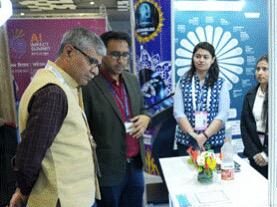
Leading this vision is Vaidya Rajesh Kotecha, Secretary, Ministry of Ayush, who reviewed the exhibits alongside Vaidya Rabinarayan Acharya, Director General of the Central Council for Research in Ayurvedic Sciences. Their walkthrough was not ceremonial. It was strategic. They examined how AI-powered chatbots, digital public health tools, and computer vision applications are being embedded into Ayush systems to strengthen service delivery, research and governance.
And the message was clear: this is not digitisation for optics. This is digital transformation for scale.
One of the Pavilion’s biggest attractions has been the Yoga Posture AI – a computer vision-based solution that enables users to assess, correct and accurately perform Yoga asanas in real time. For decades, Yoga instruction depended on physical presence. Today, using AI-driven posture recognition, a practitioner in a remote village or a foreign country can receive real-time feedback on alignment, safety and precision.
This is not about replacing the guru. It is about amplifying access.
Equally compelling are the AI-powered chatbots designed to support citizens, practitioners and institutions. These intelligent systems provide personalised wellness guidance, navigate Ayush services and help users access authenticated knowledge repositories. In a country where misinformation spreads faster than medicine, structured AI-based guidance anchored in verified datasets is not just innovation – it is public health reform.
Kotecha’s articulation of this vision was sharp and strategic. India’s Sovereign AI Models, he noted, must strengthen the Ayush digital ecosystem while ensuring data integrity, inclusivity and global interoperability. This is not accidental phrasing. Sovereign AI is not a fashionable term; it is a necessity in a healthcare ecosystem built on indigenous knowledge. If data is the new oil, traditional knowledge is civilisational capital. Both must be protected, structured and scaled responsibly.
The architectural backbone of this transformation is the Ayush Grid – India’s digital public health infrastructure for traditional medicine. At its core lies the My Ayush Integrated Services Portal (MAISP), a unified gateway integrating healthcare services, education, research, medicinal plant information, drug administration and public outreach through a single platform.
This is where policy meets platform.
The Ayush Grid is not merely a database. It is an ecosystem designed to make authentic Ayush services accessible, traceable and technology-enabled. From research analytics to regulatory transparency, from practitioner verification to citizen access – it represents an attempt to bring coherence to a sector that has historically operated in fragmented silos.
Live demonstrations at the Pavilion have reinforced that this is not theoretical ambition. Visitors interacted directly with AI tools under development for clinical decision support, standardisation protocols, research analytics and public health outreach across Ayush disciplines. Each tool carries a quiet but powerful assertion: that traditional medicine is not anti-science – it is awaiting structured science.
The Pavilion also highlights collaborative research from the IIT Jodhpur Centre of Excellence, showcasing emerging AI applications at the intersection of digital health and traditional medicine. This is critical. Innovation cannot remain confined within ministries. It must connect academia, startups and policy institutions.
The IndiaAI–Ministry of Ayush Innovation Challenge has attracted particular attention from startups and researchers, signalling that young innovators see opportunity in building AI-driven public health applications rooted in Indian systems. For a generation raised on code and computation, Ayush is no longer an ancient manuscript – it is a data-rich frontier.
Importantly, the Secretary’s engagement extended beyond his own Pavilion. Interactions with Sarvam AI, MeitY, Meta and Google demonstrate an understanding that ecosystem-building requires collaboration across public and private sectors. Traditional knowledge must converse with frontier technology – not compete with it.
The larger narrative emerging from the Ayush Pavilion is simple yet profound: India does not have to choose between tradition and technology. It can lead by integrating both.
Artificial intelligence is reshaping healthcare globally – from diagnostics to drug discovery. But healthcare is not merely a technical discipline; it is cultural, behavioural and preventive. Systems like Ayurveda and Yoga emphasise personalised wellness, lifestyle balance and preventive care – areas where AI’s predictive capabilities can be transformative.
If deployed responsibly, AI can help decode patterns in classical texts, standardise treatment pathways, strengthen evidence generation and expand global access to authenticated practices. But this must be done with caution, ethical safeguards and sovereign control over data.
The Ayush Pavilion at the India–AI Impact Summit 2026 is therefore more than an exhibition space. It is a statement of intent.
India’s AI journey will not be derivative. It will be distinctive.
In the quiet confidence of a Yoga Posture AI correcting alignment in real time, in a chatbot guiding a citizen toward evidence-based wellness advice, in a unified digital grid connecting practitioners across states – one sees the contours of a new model of healthcare.
Ancient in wisdom. Modern in execution. Sovereign in design. And unmistakably Indian.