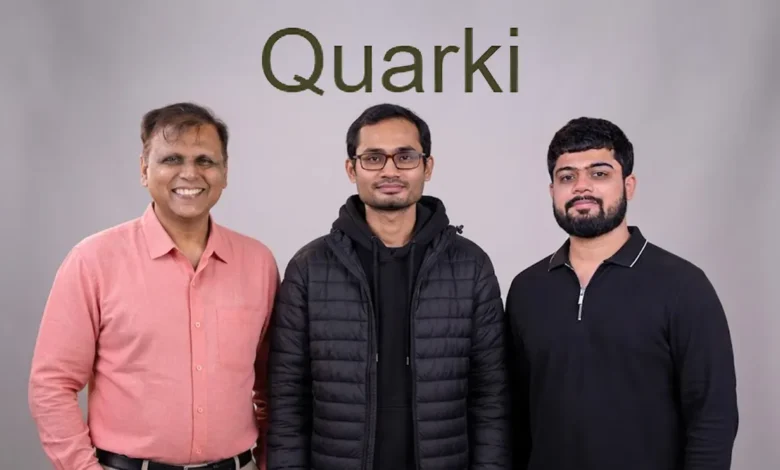
Quarkitech, a deep-tech business, has raised Rs 2 crore in a pre-seed fundraising round from Finvolve and Artha Access, a program of Artha Venture Fund II.
Additionally, under the National Quantum Mission, a national initiative authorized by the Union Cabinet in 2023, the Chennai-based business was awarded a Rs 1.5 crore grant by the IITM-CDOT Samgnya Technologies Foundation.
According to a news statement from Quarkitech, the money will be used to create a core compression algorithm library that minimizes sensor data at the source before it is stored, processed, or sent.
Quarkitech, which was founded in January 2025 by Rajesh Narayanan, Sanyam Parashar, Shashikant Singh Kunwar, and Vishnu P.K., creates simulation and quantum-inspired algorithmic solvers for large-scale combinatorial optimization in fields including deep research, finance, and mission-critical applications.
Depending on the type of sensor, the startup’s algorithms can compress sensor data by 10 to 100 times while preserving application-relevant information. According to the business, this can enable platforms to send more useful data while adhering to current power and bandwidth limitations without the need for further hardware or communication infrastructure.
It can operate on current compute infrastructure without the need for specialized hardware because its algorithm library is hardware-agnostic. It can be integrated with onboard computers used in UAVs, satellites, and ground systems, and it can be deployed across CPUs and GPUs that are already accessible on platforms. Additionally, other sensor data streams, including as radar, LiDAR, hyperspectral, and electro-optical images, can be tuned for the algorithms.
Quarkitech claimed that during laboratory testing, its technique preserved 98% of mission-critical information in drone-captured photos while reducing data volume by 26 times. The business is currently attempting to verify these findings in real-world settings, such as moving platforms and settings with heat, vibration, low onboard power, and sporadic connectivity.
Applications such as UAV and surveillance platforms, satellite earth-observation payloads, radar and LiDAR mapping systems, and ground-based sensor processing are among those where sensor-generated data surpasses available transmission capacity. The strategy can also be used for other communications and infrastructure use cases with limited bandwidth, according to the business.