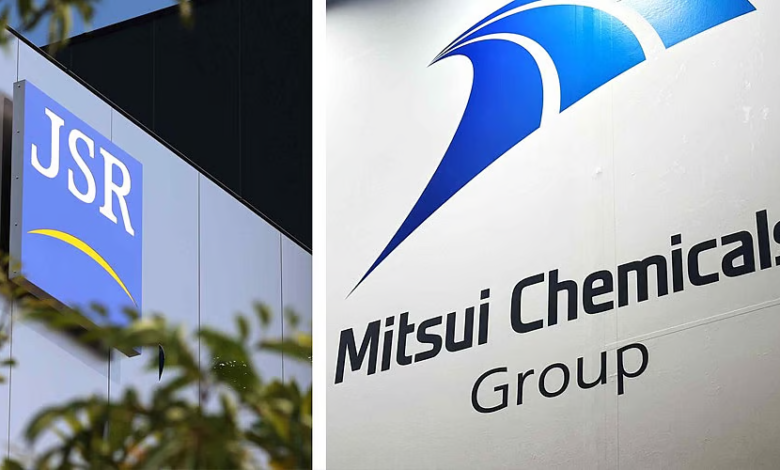
Mitsui Chemicals has agreed to acquire semiconductor materials manufacturer JSR, together with the Development Bank of Japan (DBJ), in a deal valued at 1.84 trillion yen, or approximately $11.6 billion. The acquisition will create a larger Japanese supplier of materials used in advanced semiconductor manufacturing.
The Tokyo-based chemicals company said its board approved the deal on November 9 and entered into a share purchase agreement with funds managed by JIC Capital. Under the agreement, Mitsui Chemicals and DBJ will acquire JSR’s common shares and separately purchase two categories of preferred shares held by Mizuho Bank and DBJ.
Following the transaction, Mitsui Chemicals will own all voting rights in JSR. DBJ will invest 200 billion yen and eventually hold non-voting preferred shares, according to the company’s filing.
The stated acquisition value of 1.84 trillion yen comprises an equity value of 1.3921 trillion yen, including DBJ’s investment, and 447.9 billion yen in interest-bearing debt and other items. The final transaction consideration will be subject to adjustments at closing.
JSR develops and manufactures advanced materials for the semiconductor and display industries. Its product portfolio includes photoresists, which are light-sensitive materials used to transfer circuit patterns during semiconductor lithography, along with materials required for other chip manufacturing processes.
For the financial year ended March 2026, JSR reported revenue of 440.72 billion yen and a profit attributable to owners of 59.33 billion yen. The company also owns Inpria, a US-based developer of metal-oxide resists used in extreme ultraviolet lithography.
Deal aims to strengthen Japan’s semiconductor materials industry
Mitsui Chemicals plans to make JSR the central part of its information and communications technology solutions business. It intends to combine JSR’s advanced photoresist portfolio with its existing semiconductor materials, including pellicles used to protect photomasks, as well as tapes and thick-film resists used in chip packaging.
The acquisition holds significance for Asia’s semiconductor supply chain, as JSR has research, development and manufacturing operations in Japan and South Korea, while supplying chipmakers worldwide. Japan has been working to strengthen its domestic capabilities in materials and equipment required for advanced semiconductor production, alongside major regional semiconductor-materials markets such as Taiwan, South Korea and China.
Following the completion of the deal, Mitsui Chemicals plans to increase investments in research and development, talent and manufacturing facilities. The company estimates that revenue growth and cost synergies could contribute approximately 40 billion yen in additional annual profit by fiscal 2035. This remains a company projection and is not a guaranteed outcome.
Bridge financing and regulatory clearances
Mitsui Chemicals intends to finance the acquisition through a 1.64 trillion-yen bridge loan from its main financial institutions, alongside DBJ’s 200-billion-yen investment. The company expects its net debt-to-earnings multiple to temporarily rise above four times following the transaction.
It plans to refinance the bridge loan through a combination of bank borrowings, bonds and equity. Mitsui Chemicals has filed a shelf registration for the issuance of up to 150 billion yen in common shares. It is also evaluating mezzanine financing options that rating agencies may partially classify as equity.
The transaction is subject to competition and foreign investment clearances in Japan and other jurisdictions. Mitsui Chemicals is aiming to complete the acquisition in the second half of the fiscal year ending March 2028, although the timeline may change depending on regulatory processes.
The deal will transfer JSR from funds controlled by state-backed Japan Investment Corporation, which took the company private in 2024.