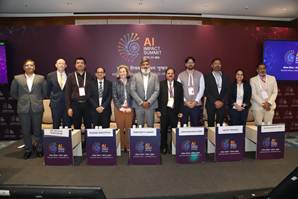
While much of the noise at the India AI Impact Summit 2026 in New Delhi revolved around robot dogs and flashy tech showcases, one of the most consequential conversations for India’s future quietly unfolded under the stewardship of the Ministry of Earth Sciences. The high-level panel titled “AI for Our Oceans of Tomorrow: Data, Models and Governance” may not have trended on social media – but it touched the very nerve of India’s survival, security, and prosperity.
Let me say this bluntly: if India ignores its oceans, it ignores its future.
The oceans regulate our climate, fuel our fisheries, power our ports, and shield our coastlines. They are not romantic backdrops for postcards from Goa or Kerala. They are strategic assets. And increasingly, they are under stress – from climate change, rising sea levels, ocean acidification, and extreme weather events.
In his keynote, Dr. M. Mohapatra, Director General of the India Meteorological Department, reminded the audience of a hard-earned truth: India’s technological investments in cyclone forecasting and early warning systems have drastically reduced loss of life over the past decade. We have moved from reactive tragedy to predictive governance. That transformation did not happen by accident. It happened because India invested in science.
Now, the next frontier is Artificial Intelligence.
Traditional physical ocean models remain essential, but the scale and speed of climate change demand something more adaptive, more predictive, and more integrative. AI-enabled models can process vast streams of marine data – temperature, currents, salinity, biodiversity signals – and translate them into actionable intelligence. In a country with over 7,500 kilometres of coastline and millions dependent on marine livelihoods, this is not optional innovation. It is strategic necessity.
The conversation also spotlighted India’s Deep Ocean Mission – a flagship initiative focused on deep-sea exploration, offshore energy, biodiversity conservation, and sustainable utilisation of marine resources. For a country aspiring to become a developed economy, tapping into deep-sea minerals, offshore renewable energy, and marine biotechnology could redefine the contours of our Blue Economy.
But here lies the challenge: oceans are vast, transboundary, and data-scarce. Unlike terrestrial systems, marine ecosystems do not respect national borders. Data gaps remain enormous. This is where AI, particularly physics-informed AI, becomes crucial – blending physical models with machine learning to generate more accurate forecasts and governance insights.
Interestingly, one of the most forward-looking perspectives came from Her Excellency May-Elin Stener, Ambassador of Norway to India. Norway, a maritime powerhouse, understands oceans not merely as geography but as economic lifelines. She emphasised that AI can revolutionise fisheries management, optimise shipping routes, improve port efficiency, and enhance coastal resilience – provided digital systems are open, interoperable, and trusted.
That word – trusted – is critical.
India’s leadership in digital public infrastructure – whether through digital identity, payments, or data architecture – gives it a unique opportunity. We are not merely consumers of global technology. We are builders of scalable digital ecosystems. The suggestion that India could pioneer a Global Digital Ocean Framework based on open standards and shared governance is not far-fetched. In fact, it is strategically sound.
The panel’s larger assertion was bold: India is uniquely positioned to lead the Global South in building a Digital Ocean Infrastructure. Imagine an integrated platform where open marine data, AI-driven analytics, and governance frameworks converge – enabling fishermen to access real-time advisories, ports to streamline logistics, disaster agencies to anticipate storm surges, and policymakers to plan coastal development with scientific precision.
This is not science fiction. It is policy waiting for political will.
However, let us not romanticise AI as a magic wand. The ocean domain remains complex and uncertain. Datasets are fragmented. International cooperation is inconsistent. Investment in marine research still lags behind terrestrial sectors. Without supportive policies, data liquidity, blended finance, and risk-sharing mechanisms, the Blue Economy will remain a buzzword rather than a growth engine.
Yet the potential is enormous.
The Blue Economy can generate large-scale employment, attract investment, strengthen food security, and enhance India’s strategic maritime posture. For coastal states – including Goa – this conversation is deeply personal. Sustainable marine governance determines the fate of fishing communities, tourism economies, and fragile ecosystems.
In his concluding remarks, Dr. (Cdr) P. K. Srivastava reiterated the Ministry’s commitment to building a structured pathway for AI integration across ocean-related programmes. That is reassuring. But implementation, not intention, will define success.
India stands at a pivotal moment. As climate volatility intensifies and geopolitical competition shifts towards maritime domains, ocean governance can no longer remain peripheral. AI must become an instrument of sovereignty, resilience, and growth – not merely a conference theme.
The India AI Impact Summit 2026 will be remembered for many things. But if India truly embraces AI for its oceans – responsibly, strategically, and collaboratively – history may record that this was the moment when we stopped looking at the sea as a boundary and started seeing it as a bridge.
The future of India may very well be written in algorithms – but it will be tested in the tides.