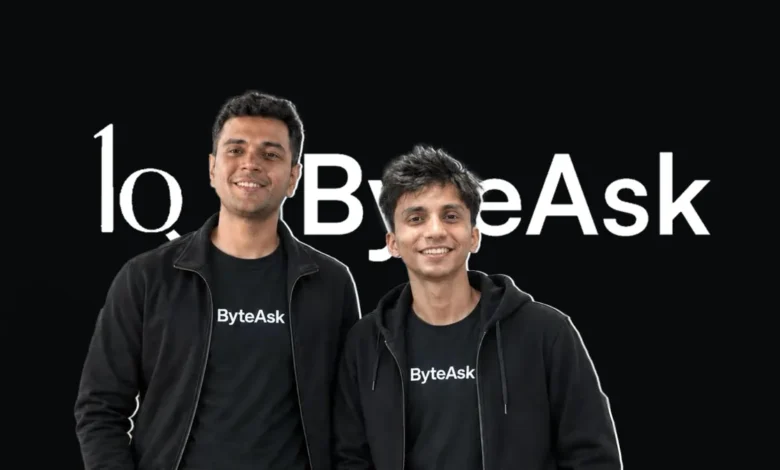
AI coding agent startup ByteAsk has raised $1 million in a pre-seed round led by Y Combinator and Entrepreneur First, alongside participation from angel investors.
ByteAsk was founded by Anirudha Kulkarni and Pratyush Saini, who previously founded legal AI startup LawSutra AI and sold it to Manupatra, an online legal research platform.
The newly raised capital will be directed towards product and infrastructure development, engineering and research hiring, GPU computing and training data. The company also intends to develop enterprise-grade security, privacy and on-premises infrastructure for its customers.
Founded in 2026, ByteAsk is developing AI coding agents designed specifically for C and C++ codebases. Its platform targets engineers working on mission-critical applications across sectors including defence, aerospace, robotics, high-frequency trading, finance, embedded systems, automotive and semiconductors.
The startup aims to tackle the limitations of existing AI coding tools when used for C and C++ development, particularly in areas where reliability, performance and code correctness are essential.
ByteAsk estimates that C++ accounts for around $400 billion in annual engineering salary expenditure across the industry. The company also estimates the market opportunity for agentic coding at approximately $10 billion, with the segment expanding rapidly.
Initially, ByteAsk plans to focus on large enterprises in high-frequency trading, automotive and embedded systems, before moving into adjacent sectors. The company claims its engineers use the platform roughly six times more intensively per day than a comparable open-source coding agent, while its weekly active users are growing at a rate of twofold week on week.
In an internal benchmark using real firmware engineering tickets, ByteAsk said its grounding environment allowed a smaller model to resolve 89% of the tickets. By comparison, the best frontier model tested without the environment resolved 61%.
The company is also working on a post-training approach specifically for C++. It plans to launch a language model post-trained for C++ within the next six to eight months.