Singapore fintech iPiD raises $16 M Series A funding from Foundation Capital

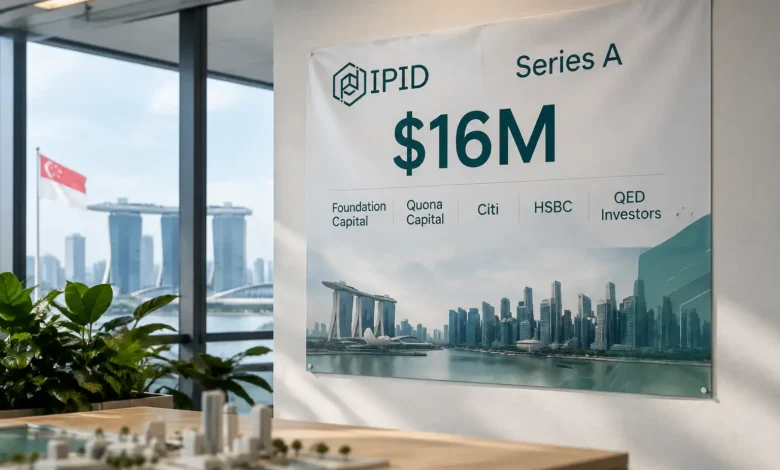
Singapore-headquartered payment intelligence company iPiD has raised $16 million in a Series A funding round led by Foundation Capital, with strategic participation from Citi and HSBC. The company plans to use the capital to expand its payee-verification network and develop capabilities for faster payment systems and digital assets.
The company announced the financing on September 24, while Axios separately reported the round and said iPiD is expanding account-verification coverage as the growing adoption of instant payments leaves less time to identify errors and fraud before transactions are completed.
Existing backers QED Investors, Monk’s Hill Ventures and Quona Capital also participated in the latest financing.
iPiD targets wider payment intelligence coverage
The new funding will be used to broaden iPiD’s global payment intelligence network, expand its presence in the US and Europe, and build products supporting US payment rails, stablecoins and other digital assets.
iPiD specialises in payee verification, allowing banks, payment companies and businesses to check whether a recipient account is legitimate and whether its details correspond with the intended beneficiary before a payment is processed. The company refers to this model as “Know Your Payee”, positioning it as a complement to know-your-customer processes that primarily verify the sender.
According to iPiD, its network currently connects with financial institutions across more than 50 countries. The company says its direct integrations and distribution partnerships provide access to more than 6,500 financial institutions and approximately 4 billion bank accounts. These coverage figures are based on company-provided data.
The company is building its verification infrastructure as real-time payments become increasingly widespread. While instant settlement can make payments more convenient, it also reduces the window available to identify incorrect account details, beneficiary mismatches and fraudulent destinations before money is transferred.
Citi and HSBC add strategic backing
Citi and HSBC invested in the Series A as strategic participants, with both banks already maintaining commercial relationships with iPiD.
iPiD said Citi incorporates its technology into Citi Verify, while HSBC uses the platform to extend beneficiary verification beyond domestic validation systems. Other customers and partners include Visa, Nium, Experian, Tazapay and several other financial and payments companies.
Foundation Capital partner Zach Noorani said iPiD has developed a global verification layer outside the traditional bank-consortium structure. Executives from Citi and HSBC similarly pointed to beneficiary verification as a way to reduce payment uncertainty and strengthen fraud controls.
The participation of two major banks also gives the round significance beyond the capital raised. iPiD’s ability to scale depends partly on connecting with fragmented banking and payment infrastructure across different markets, making institutional partnerships important to its coverage strategy.
iPiD builds on earlier funding
Founded in 2021 by payments executives with backgrounds at SWIFT and other financial-technology companies, iPiD is headquartered in Singapore and has operations in London, New York, Dubai, Amsterdam, Brussels, Kuala Lumpur and Mumbai.
The Series A follows two earlier funding rounds. In 2022, the company secured $3.3 million in seed funding from investors including Rapyd Ventures, Jungle Ventures and 1982 Ventures. Two years later, iPiD raised $5.3 million in an oversubscribed pre-Series A led by Monk’s Hill Ventures, with QED Investors and Quona Capital also participating.
The latest financing marks a new phase of institutional expansion for iPiD. Alongside traditional bank-account verification, the company is now looking to extend its infrastructure to stablecoin wallets and other digital-payment destinations.
iPiD has not disclosed its valuation following the Series A. It also has not provided a specific timeline for launching its planned US and digital-asset products. The expansion plans therefore remain company targets until the related products and customer deployments are formally rolled out.