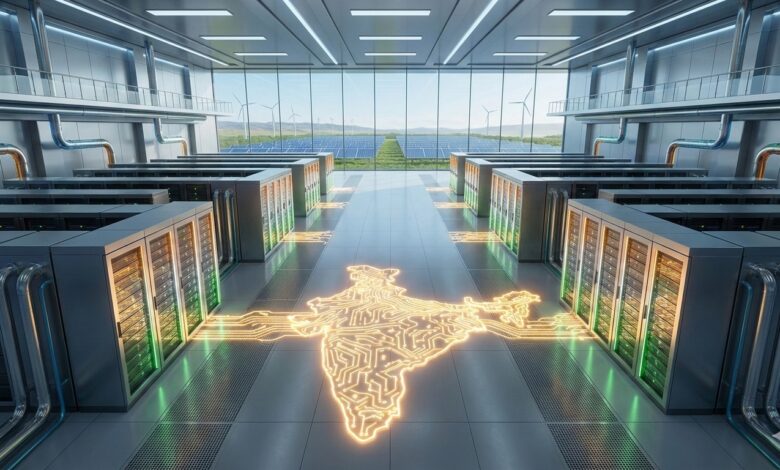
India stands at the edge of a technological inflection point. Not a fashionable buzzword moment. Not another PowerPoint-driven illusion. But a hard, steel-and-silicon revolution powered by artificial intelligence and anchored in data sovereignty.
The India artificial intelligence data center market, valued at USD 1.19 billion in 2025, is projected to surge to USD 3.10 billion by 2030. That is a 21.08% CAGR – not incremental growth, but strategic acceleration. This is not just about servers humming in glass buildings. It is about national power, economic leverage, and digital independence.
For decades, we outsourced manufacturing. We allowed supply chains to drift. But data – the new oil, the new uranium, the new currency – cannot be outsourced. And India is finally recognising that sovereign data processing is not a cost centre. It is a national capability.
AI Data Centres: The New Strategic Assets
Artificial intelligence workloads are unlike traditional computing demands. They are power-hungry, latency-sensitive, and compute-intensive. Modern AI racks routinely draw 30 kW or more per rack. This is no longer a small enterprise server room. These are industrial-scale digital power plants.
And where is this transformation most visible? Along the Mumbai-Bangalore corridor – India’s digital spine. It is here that hyper-scale roll-outs are accelerating. It is here that submarine cable connectivity intersects with cloud availability zones and state incentives. It is here that global hyper-scalers and domestic colocation specialists are aggressively banking land.
Why? Because geography now equals advantage.
Mumbai connects India to global internet backbones through submarine cables. Bangalore anchors India’s innovation ecosystem. Between these two lies the future of India’s AI infrastructure dominance.
Cloud Dominance – But Colocation Rising Fast
By data center type, cloud service providers commanded 55.82% of revenue share in 2024. That is expected. Hyperscalers are first movers. They have capital muscle, technology scale, and client ecosystems.
But here is the interesting story: colocation facilities are projected to expand at a 22.67% CAGR through 2030 – faster than the overall market. That means enterprises are no longer content simply consuming cloud. They want strategic control. They want hybrid models. They want regulatory compliance without losing flexibility.
In other words, Indian businesses are maturing.
This shift reflects a deeper reality. Data localisation mandates are no longer theoretical policy debates. They are operational realities. Sensitive financial, healthcare, defence, and governance data must reside within India’s borders. And that fuels demand for domestic, secure, compliant infrastructure.
This is not protectionism. This is prudence.
Software Leads – Hardware Accelerates
Software maintained a 45.83% share of the market in 2024. That reflects AI orchestration platforms, automation tools, and management frameworks. But hardware investment is advancing at a 22.23% CAGR to 2030.
Why does this matter?
Because AI without hardware is like ambition without execution. GPUs, high-density compute clusters, advanced cooling systems, edge accelerators – these are capital-intensive commitments. And India is investing.
The demand for energy-efficient AI hardware is not cosmetic sustainability theatre. When racks consume 30 kW and more, power becomes the defining constraint. Electricity costs, grid reliability, and carbon compliance are strategic considerations.
That is why renewable-rich power purchase agreements (PPAs) are backing Tier IV sites. That is why energy efficiency is not just environmental virtue – it is competitive advantage.
India’s renewable energy push, often debated in ideological tones, now intersects with hard business logic. AI data centres need clean, stable, scalable power. Renewable-backed PPAs provide long-term price predictability. Investors love predictability.
Tier IV Dominance – Tier III Momentum
Tier IV sites accounted for 61.63% of market share in 2024. That tells you something fundamental: enterprises want maximum uptime, fault tolerance, and redundancy. In AI-driven environments, downtime is not an inconvenience. It is reputational damage, operational paralysis, and financial loss.
Yet Tier III deployments exhibit the highest 23.44% CAGR through 2030.
Why?
Because India is not one market. It is many India’s. Metro hyper-scale facilities coexist with emerging city deployments. Tier III offers a balance of reliability and cost efficiency for enterprises expanding AI workloads outside traditional hubs.
This is digital federalism at work.
The National 5G/6G Mission is pushing low-latency applications deeper into public and enterprise ecosystems. Smart manufacturing, telemedicine, real-time analytics – these require distributed compute. Not everything can be centralised in Mumbai or Bangalore.
Edge and regional data centres will define the next wave.
IT and ITES Lead – Digital Media Surges
IT and ITES held a 33.82% share in 2024. Predictable. India’s services economy is deeply digital. AI enhances automation, cybersecurity, analytics, and customer experience layers.
But internet and digital media workloads are rising at a 22.45% CAGR through 2030.
Streaming platforms. Gaming. Creator economies. Real-time advertising analytics. These are AI-intensive workloads. India’s young demographic, smartphone penetration, and 5G rollout create explosive demand.
Data centres are not abstract infrastructure. They are the unseen engine behind every reel, every stream, every AI-generated insight.
Policy: The Silent Force Multiplier
Three inter-related policy initiatives are quietly reshaping this landscape:
The IndiaAI Mission.
The Production Linked Incentive (PLI) scheme.
The National 5G/6G Mission.
Together, they form a policy triangle that drives AI deeper into enterprise and public-sector operations.
The IndiaAI Mission signals intent – India will not merely consume AI; it will build and deploy it.
The PLI scheme incentivises domestic manufacturing ecosystems – chips, components, and associated supply chains.
The 5G/6G Mission creates the high-speed backbone that makes AI applications viable at scale.
Policy alignment reduces investor uncertainty. Capital flows toward clarity.
The Geopolitical Layer
Let us not be naive. Artificial intelligence is no longer a neutral technology. It is a geopolitical instrument.
Data centres are sovereign assets. Whoever controls compute controls intelligence. Whoever controls intelligence shapes policy, markets, and influence.
India’s insistence on data localisation and sovereign processing capability is not paranoia. It is strategic foresight. In an era where algorithms influence elections, markets, and security paradigms, national compute capacity becomes as vital as physical defence infrastructure.
The intersection of submarine cable connectivity, cloud zones, and state incentives is not accidental. It is competitive positioning. States offering land, power subsidies, and regulatory speed are competing for the AI future.
Aggressive land banking by hyperscalers and colocation specialists is not speculation. It is long-term territorial staking.
The Energy Question
Every AI data centre conversation must confront one unavoidable truth: power.
High-density racks drawing 30 kW or more change grid dynamics. Utilities must upgrade transmission infrastructure. Renewable integration must be scaled. Battery storage and smart grid technologies become essential.
India’s energy transition and AI expansion are now intertwined destinies.
If we solve energy, we unlock AI scale. If we fail energy planning, AI growth will stall under capacity constraints.
The Bigger Picture
A market growing from USD 1.19 billion to USD 3.10 billion in five years is not merely a business statistic. It is a signal.
India is shifting from being a software back office to becoming an AI infrastructure powerhouse.
The narrative is evolving. We are no longer just exporting code. We are hosting compute. We are attracting hyper-scale capital. We are building sovereign capacity.
But with opportunity comes responsibility.
Cybersecurity standards must rise. Regulatory clarity must remain consistent. Environmental compliance must be balanced with growth. Skill development must keep pace with technological complexity.
If India gets this right, the AI data centre boom will do more than boost GDP. It will reposition the nation in the global digital order.
This is not a passing cycle. It is structural transformation.
Steel, silicon, renewable power, submarine cables, policy incentives – these are the building blocks of India’s AI century.
And the question is no longer whether India will participate.
The question is whether India will lead.