Singapore’s Acti bags $5.3 M Seed Funding to build AI-Driven personal context layer

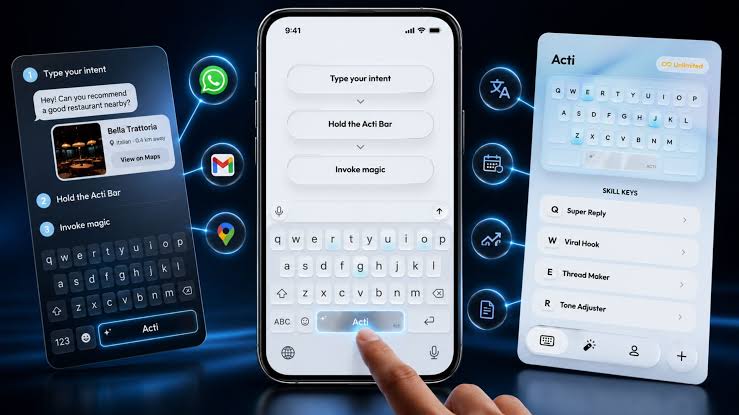
Singapore-based startup Acti, which describes itself as the world’s first agentic keyboard, has raised $5.3 million in a seed funding round led by U.S.-based BITKRAFT Ventures.
According to a statement released on Tuesday, Acti transforms the keyboard into an AI-powered context layer that functions across every application a user interacts with. The fresh capital will be used to expand the company’s engineering and AI teams, enhance its on-device intelligence capabilities, and grow its Skill ecosystem and developer community.
The company’s long-term vision is to create a secure, user-controlled personal context layer for the AI agent era. As users continue interacting with Acti, the platform learns their habits, preferred applications, and recurring workflows, storing that information locally on the device rather than within a centralized platform, giving users greater control over their data.
Instead of requiring users to switch between applications or repeatedly provide context to AI assistants, Acti embeds AI functionality directly into the keyboard through programmable Skill Keys. Users can assign customized actions to individual keys—for example, translating a message with a long press or instantly sharing a meeting link—without writing any code.
The platform also includes a Skill Builder, allowing users to describe the functionality they want in natural language, after which Acti automatically creates the corresponding workflow. During its early access phase, users built more than 1,000 Skills in less than two weeks.
Jonathan Huang, Partner at BITKRAFT Ventures, said the company is well positioned to shape the next generation of human-computer interaction, adding that Acti is redefining the keyboard—the one interface common to virtually every application—into an essential layer for future AI agents.
Young Wang, Acti’s founder and CEO, said today’s AI agents remain constrained because user context is scattered across multiple applications. By maintaining a presence across apps, Acti can build a unified context layer that belongs to users themselves rather than to any single platform, he added.