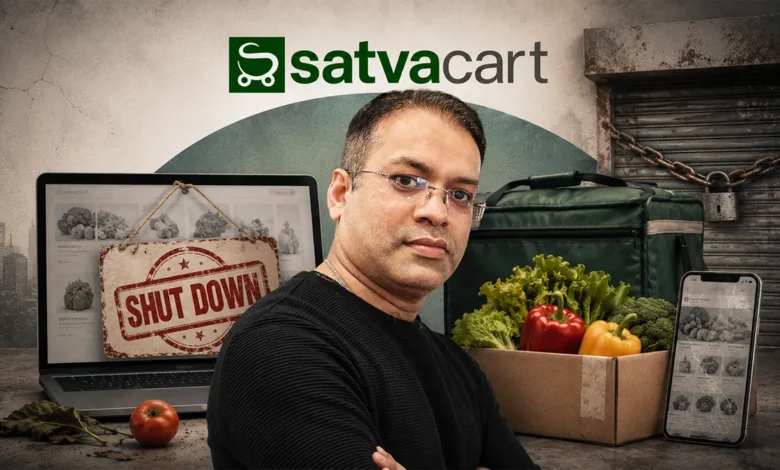
After 12 years of business, the Gurugram-based e-grocery startup Satvacart has closed. Rahul H. Saxena, the team’s creator, stated in a LinkedIn post that August 28 was the last day of activities before the organization was dissolved.
Satvacart investigated finance, strategic investment, and acquisition alternatives for a number of difficult years prior to the shutdown. Saxena claims that the company received funding primarily in smaller installments, which was not enough to restore and grow the company.
“We continued pushing till the very end and explored every realistic funding, strategic investment and acquisition option available to us,” Saxena said.
Additionally, Satvacart was negotiating a sizable investment with two larger investors; however, neither transaction came to pass. The startup also discussed acquisitions with other parties, but none of them moved forward.
According to Saxena, Satvacart’s profit-driven strategy did not produce the scale that prospective acquirers and investors were seeking.
“The past few months had become increasingly difficult,” he said, adding that continuing operations had reached a point where it was coming at the cost of people who had stood by the company.
Satvacart was one of the first online grocery retailers in India, having been founded in 2014. Before switching to an inventory-led food delivery approach and using independent warehouses and microclusters, the company started with milk subscriptions in Gurugram in January 2016.
Palaash Ventures and angel investors provided seed money to the firm in 2015 so that it could grow, attract clients, and bolster its technical staff.
Satvacart concentrated on measured growth and profitability, in contrast to many rivals that pursued aggressive customer acquisition and expansion. According to Saxena, the business was one of the first online grocery retailers to show profitability in 2019.
But since then, the grocery business has drastically changed to focus on rapid commerce, with companies like Blinkit, Zepto, and Swiggy Instamart competing on scalability, dark-store density, and delivery speed. With Amazon Now and Flipkart Minutes, respectively, e-commerce behemoths Amazon and Flipkart have also joined the market.
As the competition moved more and more toward scale-driven models, Satvacart’s lower scale made it more difficult to draw in larger institutional investors and strategic purchasers.
In retrospect, Saxena stated that he had no regrets about closing the company.
“I genuinely believe I gave Satvacart the very best effort I was capable of,” he said.
After 12 years of building the company across technology, operations, fundraising, marketing, supply chain and customer experience, Saxena concluded: “As this chapter closes, I look forward to the next one.”