Ayati Devices raises Rs 15 Cr Pre-series A funding from Inflexor Ventures

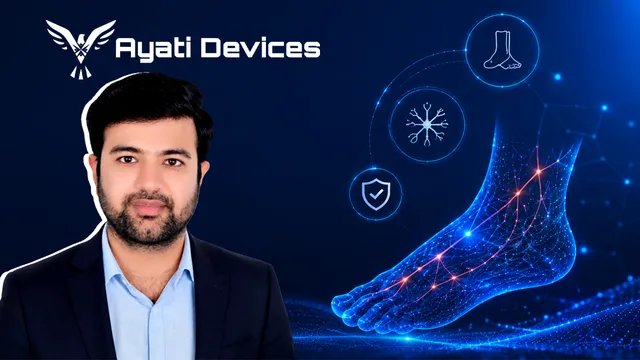
Ayati Devices, a medical technology business based in Bengaluru, has raised Rs 15 crore ($1.5 million) in a Pre-Series A fundraising round headed by Inflexor Ventures.
The money will be used to develop manufacturing capabilities, boost investments in research and artificial intelligence, speed commercialization, and increase its footprint in both home and foreign markets.
Nishant Kathpal founded Ayati Devices in 2019 with a focus on peripheral vascular disease and diabetic foot problems. The business, which was housed at the Society for Innovation and Entrepreneurship (SINE) at IIT Bombay, has developed a line of portable, point-of-care diagnostic tools with the goal of expanding access to early screening outside of tertiary hospitals.
Several phases of diabetic foot examination are covered by its product line. Vibrasense+T incorporates warm and cold perception tests, whereas Vibrasense evaluates vibration perception threshold to detect large-fibre peripheral neuropathy.
While Angiocam allows for real-time tissue perfusion imaging, Vasosense is intended for peripheral artery disease screening. Additionally, the company offers the PODIA Trolley, a pay-per-test screening strategy intended to lower the initial outlay of funds needed by healthcare providers. The current Ayati platform combines evaluations of microcirculation, neuropathy, blood flow, and plantar pressure.
With over 10,000 devices installed including clinical deployments in top healthcare facilities, Ayati claims to have been implemented in 30 countries. According to the company’s website, over a million screenings have been made possible by its solutions, and it collaborates with partners in both Indian and foreign markets.
Clinical testing has also been done on the company’s flagship product, Vibrasense. In order to screen for diabetic peripheral neuropathy, a study comprising 562 individuals with type 2 diabetes compared Vibrasense-based vibration perception threshold testing with traditional biothesiometry and nerve conduction investigations.